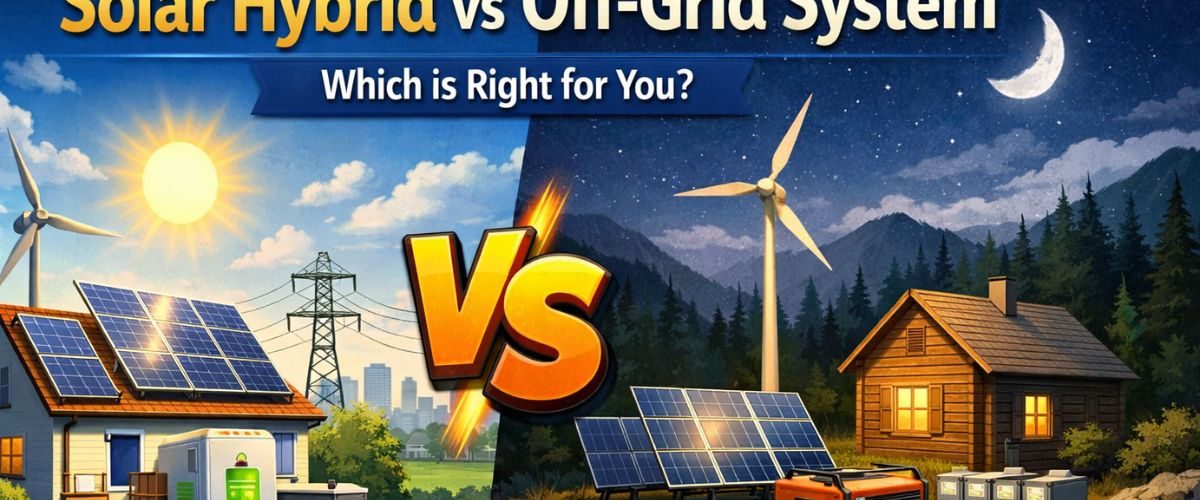
Switching to solar is one of the smartest decisions you can make in 2026. With rising electricity bills and better solar technology available at lower prices, more and more homes and businesses across India are making the move.
But when you start researching, you quickly run into a question that confuses most people: “Should I go for a solar hybrid system or an off-grid solar system?”
Both systems use solar panels. Both use batteries. But they are designed for very different situations and choosing the wrong one can mean spending more money than necessary, or being left without power when you need it most.
In this guide, we will break down everything in plain, simple language, no technical jargon, no confusing diagrams. By the end, you will know exactly which system makes sense for your home, your budget, and your lifestyle.
| Quick Answer
If you live in a city or town with a working electricity grid go for a Hybrid System. If you live in a remote area where grid power is unavailable or extremely unreliable go for an Off-Grid System. Read on to understand why. |
What is a Solar Hybrid System?
A solar hybrid system connects your home to three sources of power: solar panels, a battery bank, and the electricity grid. Think of it like a smart switching system that always picks the cheapest and cleanest power source available.
Here is how it works step by step:
- During the day, your solar panels generate electricity. Your home uses this solar power directly.
- If your panels produce more electricity than your home needs, the extra power goes into the battery to charge it.
- If the battery is also fully charged and solar is still producing extra, that surplus electricity can be sent back to the main grid and you may get credit for it (this is called net metering).
- In the evening or at night, your home switches to the stored battery power.
- If the battery runs low (on a cloudy day, for example), the grid automatically kicks in so you never face a blackout.
What is an Off-Grid Solar System?
An off-grid solar system is completely independent. There is no connection to the electricity grid at all. Your home runs entirely on solar panels and a battery bank — and nothing else.
Here is how it works:
- During the day, solar panels generate electricity and power your home. 7. Extra power charges a large battery bank.
- At night, the stored battery power runs your home.
- On cloudy or rainy days, you rely on whatever is stored in the battery.
- If the battery drains completely — there is no backup. No power until the sun comes back.
Key Point: An off-grid system gives you complete energy independence — but it requires careful planning and a larger battery bank to ensure you never run out.
What Are the Key Components of Each System?
Before we go further, it helps to understand what actually goes inside each system. Both share some common parts, but there are important differences.
| Component | Hybrid System | Off-Grid System |
| Solar Panels | Same for both — absorbs sunlight and converts it to DC electricity | Same for both |
| Hybrid Inverter | Manages solar, battery, and grid simultaneously — the brain of the system | Not used |
| Off-Grid Inverter | Not used | Manages solar and battery only — no grid connection |
| Battery Bank | Smaller capacity needed — grid acts as backup | Larger capacity needed — must cover nights + bad weather days |
| Grid Connection | Yes — connected via net metering meter | No — fully standalone |
| Net Meter | Yes — tracks power sent to/from grid | Not applicable |
| Charge Controller | Built into hybrid inverter | Separate MPPT charge controller needed |
Head-to-Head Comparison: Hybrid vs Off-Grid
Here is a detailed side-by-side comparison to help you evaluate both options:
| Feature | Solar Hybrid System | Off-Grid Solar System |
| Grid Connection | Yes — stays connected | No — fully independent |
| Battery Required | Yes, smaller bank needed | Yes, larger bank needed |
| Power at Night | Battery + Grid as backup | Battery only |
| Power on Cloudy Days | Grid automatically covers | Depends on battery reserves |
| Risk of Blackout | Very low — grid is backup | Possible if batteries drain |
| Net Metering / Sell Power | Yes — earn credits | Not applicable |
| Government Subsidy | Yes — eligible under PM Surya Ghar Yojana | Limited subsidy options |
| Ideal Location | Urban, semi-urban, cities | Remote villages, farms, hills |
| Installation Complexity | Moderate | Moderate to High |
| Maintenance Needs | Moderate (inverter + panels + battery) | Moderate to High (battery care critical) |
| Upfront Cost (3 kW) | ₹ ₹ 1.3L – 2.0L approx. | ₹ ₹ 1.55L – 2.55L approx. |
| Long-Term Savings | High — via reduced bills + net metering | Very High — zero electricity bills |
Scenario A: Hybrid System in a Delhi Home
Let’s say you have a 3 kW hybrid system installed on your rooftop in Delhi:
- 6:00 AM — Sun rises. Panels start producing power. Morning appliances (fans, lights, geysers) run on solar directly.
- 9:00 AM to 4:00 PM — Peak solar hours. Your home is fully solar-powered. Surplus charges the battery.
- 4:00 PM — Battery is fully charged. Extra solar power is exported to the grid. You earn net metering credit.
- 6:00 PM — Sun sets. Home switches to battery power. TV, AC, lights all run on stored solar energy.
- 10:00 PM — Battery at 30%. System automatically draws from the grid — silently, without any interruption.
- Next morning — Panels come back on. Cycle repeats.
Result: Your electricity bill drops by 70–90%. You barely notice the transition between solar, battery, and grid. Zero power cuts.
Scenario B: Off-Grid System on a Farm in Rajasthan
Now imagine you have a 3 kW off-grid system on a farmhouse with no grid connection:
- Daytime — Panels power the farmhouse (lights, pumps, fans) and charge a large battery bank (usually 200Ah–400Ah).
- Evening — Home runs on stored battery power.
- Night — Battery continues to supply. If sized correctly, it covers 8–12 hours of usage.
- 3 Cloudy Days in a Row — This is the critical test. A well-designed off-grid system will have enough battery reserve for 2–3 days of no sun. Usage may need to be reduced (no high-power appliances).
- Sunny Day Returns — Panels quickly recharge the battery bank. Normal usage resumes.
Result: Zero electricity bills, complete independence from the grid. But the system must be sized carefully by an expert. Undersizing the battery is the most common and costly mistake.
Who Should Choose Which System?
Here is a simple decision guide based on your situation:
| Situation 1: You are in Delhi, Noida, Gurgaon, Faridabad or any city
Recommendation — Choose: Solar Hybrid System You already have a grid connection, so a hybrid system makes total sense. Use solar during the day, battery in the evening, and the grid only as a last resort. You will also be eligible for net metering and government subsidies, which significantly reduce your payback period. |
| Situation 2: You are in a rural or semi-rural area with poor grid supply Recommendation — Choose: Solar Hybrid System (if any grid exists) or Off-Grid System
If you have a grid connection but face 6–12 hours of power cuts daily, a hybrid system still works well. However, if the grid is completely absent or extremely unreliable, an off-grid system with a larger battery bank is the better choice. |
| Situation 3: You have a farm, remote property, or holiday home
Recommendation — Choose: Off-Grid Solar System If the property is far from the main grid or used infrequently, getting a grid connection is expensive and often impractical. An off-grid system gives you full independence with no monthly bills. |
| Situation 4: You want to completely eliminate your electricity bill
Recommendation — Both can work — but Off-Grid takes it further A hybrid system can reduce your bill by 70–90%. An off-grid system can bring it to zero. However, going fully off-grid in a city often does not make financial sense because you would need a much larger battery to handle nights and cloudy days — which adds significant cost. |
How Much Does Each System Cost in India? (2026 Estimates)
Cost is one of the first questions everyone asks. Below is a realistic price breakdown for a 3 kW system installed in Delhi NCR in 2026. Note that prices vary based on brand, battery type (lithium vs lead-acid), and installer.
| Cost Component | Hybrid System (3 kW) | Off-Grid System (3 kW) |
| Solar Panels (330W x 9) | ₹ ₹ 55,000 – 70,000 | ₹ ₹ 55,000 – 70,000 |
| Inverter | ₹ ₹ 25,000 – 45,000 | ₹ ₹ 18,000 – 35,000 |
| Battery Bank | ₹ ₹ 30,000 – 60,000 | ₹ ₹ 60,000 – 1,20,000 |
| Mounting Structure (GI) | ₹ ₹ 10,000 – 18,000 | ₹ ₹ 10,000 – 18,000 |
| Wiring & BOS | ₹ ₹ 8,000 – 15,000 | ₹ ₹ 8,000 – 15,000 |
| Installation Labour | ₹ ₹ 8,000 – 12,000 | ₹ ₹ 8,000 – 12,000 |
| Total Estimated Cost | ₹ ₹ 1,36,000 – 2,20,000 | ₹ ₹ 1,59,000 – 2,70,000 |
| Govt. Subsidy Available | Yes (up to 78,000 for 3 kW) ₹ | Limited |
| Net Cost After Subsidy | ₹ ₹ 58,000 – 1,42,000 | ₹ ₹ 1,59,000 – 2,70,000 |
Why is the off-grid system more expensive? Because it needs a larger battery bank. In a hybrid system, the grid acts as a free buffer — so you need fewer batteries. In an off-grid system, you need enough battery capacity to power your home for 2–3 days with no sunlight, which significantly increases cost.
Lithium vs Lead-Acid Battery: Lithium batteries cost 2–3x more upfront but last longer (8–12 years vs 3–5 years), require zero maintenance, and perform better in heat — making them a smarter long-term investment for India’s climate.
Pros and Cons: Full Breakdown
Solar Hybrid System
| Pros | Cons |
| Lower cost than off-grid (smaller battery needed) | Requires an existing grid connection |
| Zero blackout risk — grid is always your backup | Net metering approval needed from DISCOM |
| Eligible for PM Surya Ghar government subsidy | Slightly complex installation & commissioning |
| Can earn money by exporting surplus power to grid | You still pay a small grid connection fee |
| Ideal for city homes, apartments, commercial buildings | Not an option in areas without grid access |
| Reduces electricity bill by 70–90% | Net metering rules vary by state |
Off-Grid Solar System
| Pros | Cons |
| 100% energy independent — no grid needed | Higher upfront cost (larger battery bank) |
| Zero electricity bills, ever | Risk of power outage if battery fully drains |
| Perfect for remote areas, villages, farms | Requires careful sizing — no room for error |
| Works even where grid lines have not reached | Battery replacement cost every 5–10 years |
| Great for agricultural pumps, irrigation, rural homes | Cannot export power or earn via net metering |
| Long-term savings are maximum — no
dependency on utility |
Limited subsidy options compared to hybrid |
Common Myths About Solar Systems — Debunked
There is a lot of misinformation floating around about solar. Let us clear up the most common ones:
| Myth 1: Solar panels do not work on cloudy or rainy days.
False. Solar panels still generate electricity on cloudy days — just at a lower output (typically 20–50% of peak production). Modern panels are designed to capture diffuse light. India’s rainy season is also spread over only 3–4 months, and the rest of the year delivers excellent solar irradiance. |
| Myth 2: Off-grid means you will often have no electricity.
False — if the system is properly sized. A well-designed off-grid system with adequate battery capacity will power your home through nights and overcast days without interruption. The key is working with a professional who calculates your energy needs accurately. |
| Myth 3: Hybrid systems are just fancy grid systems — the solar barely makes a difference.
False. In a properly sized hybrid system, solar covers 70–90% of your annual electricity needs. The grid is used as a backup, not a primary source. Most users find that they rarely pull from the grid at all during summer months. |
| Myth 4: Once installed, solar needs a lot of maintenance.
False. Solar systems are largely maintenance-free. The main tasks are cleaning panels every 2–4 weeks (dust and bird droppings reduce output) and an annual electrical inspection. Batteries in modern lithium systems require virtually zero maintenance. |
| Myth 5: Solar is too expensive and the payback period is too long.
False in 2026. With government subsidies of up to 78,000 on a 3 kW system, and ₹ electricity bills that have risen 8–12% year-on-year, most homeowners in Delhi NCR see a payback period of just 3–5 years. After that, electricity is essentially free for 20+ years. |
What Does the Installation Process Look Like?
Many people worry that installing a solar system is a long, disruptive process. In reality, for most homes, a 3 kW system can be fully installed and commissioned in 2–4 days. Here is a simplified overview:
| Step | Stage | What Happens |
| Step 1 | Site Survey & Design (Day 1) | A solar expert visits your property, measures your roof, checks shading, reviews your electricity bills, and designs the right system for your needs. |
| Step 2 | Proposal & Approval (Day 2–3) | You receive a detailed proposal with system design, component list, cost, savings estimate, and payback period. You approve, and the paperwork begins. |
| Step 3 | Material Procurement | Solar panels, inverter, batteries, mounting structure, and wiring are sourced. Unify Solar uses only tested, certified components. |
| Step 4 | Installation (Day 1–2) | The mounting structure is fixed to the roof, panels are installed, inverter and battery are wired, and the system is connected. |
| Step 5 | Testing &
Commissioning (Day 3–4) |
The full system is tested, output is verified, and the inverter is configured. For hybrid systems, DISCOM paperwork for net metering is also submitted. |
| Step 6 | Handover & Training | You are shown how to read the inverter dashboard, monitor your solar output, and identify any issues. Warranty documents are handed over. |
Final Thoughts: Which System Should You Choose?
Both systems are excellent investments. The solar technology available in 2026 is more reliable, more affordable, and more efficient than ever before. Whether you choose hybrid or off-grid, you are making a decision that will save you money, protect you from rising electricity rates, and reduce your carbon footprint for the next 25 years.
Still not sure which one is right for you? The simplest step is to book a free consultation. An expert will visit your site, assess your energy needs, and give you a clear, honest recommendation — with no pressure to buy.
| Get a Free Solar Consultation from Unify Solar
Unify Solar is one of Delhi NCR’s most trusted solar companies, with 50+ successful installations across residential and commercial properties. Our team offers end-to-end support — from site survey and system design to installation, net metering assistance, and ongoing O&M. Contact us today: www.unifysolar.in/contact-us/ |