
Solar energy has become one of the fastest-growing renewable energy sources in the world. At the heart of every solar power system is a solar module, which is responsible for converting sunlight into usable electricity. Whether installed on rooftops, solar farms, or commercial buildings, solar modules play a crucial role in generating clean and sustainable power.
In this article, we will explain what a solar module is, how it works, its components, and the different types of solar modules used in modern solar energy systems.
What is a Solar Module?
A solar module, also known as a solar panel, is a device made up of multiple photovoltaic (PV) cells connected together to convert sunlight into electricity. These cells are usually made from silicon, a semiconductor material that generates electric current when exposed to sunlight.
When sunlight hits the photovoltaic cells, it triggers the photovoltaic effect, which causes electrons in the cells to move and produce direct current (DC) electricity. This electricity is then converted into alternating current (AC) by an inverter so it can be used to power homes, businesses, and electrical devices.
Solar modules are the basic building blocks of solar power systems. When several modules are connected together, they form a solar array, which can generate larger amounts of electricity.
Typical solar modules produce around 250 to 400 watts of power, depending on the technology and design used.
How Solar Modules Work?
Solar modules operate using photovoltaic technology. The working process can be explained in simple steps:
- Sunlight hits the solar panel – Photons from sunlight strike the photovoltaic cells.
- Energy excites electrons – The photons transfer energy to electrons in the silicon cells.
- Electric current is generated – Electrons start moving through the circuit, creating direct current (DC).
- Electricity flows to inverter – The DC electricity flows to a solar inverter.
- Conversion to usable power – The inverter converts DC into AC electricity used by homes and businesses.
This process allows solar modules to generate electricity without producing emissions or pollution.
Components of a Solar Module
A solar module consists of several layers designed to protect the cells and maximize energy production. The main components include:
1. Solar Cells
These are the core components that convert sunlight into electricity. Most solar cells are made from crystalline silicon.
2. Tempered Glass
The top layer of the module is a strong glass sheet that protects the cells from weather, dust, and mechanical damage while allowing sunlight to pass through.
3. EVA (Encapsulation Layer)
EVA or Ethylene Vinyl Acetate protects the solar cells by sealing them and preventing moisture or dust from entering the module.
4. Backsheet
The backsheet protects the rear side of the panel and provides electrical insulation.
5. Aluminum Frame
The aluminum frame gives structural support and helps in mounting the module securely.
6. Junction Box
The junction box connects the solar module to the electrical system and includes bypass diodes that help reduce power loss caused by shading.
Types of Solar Modules
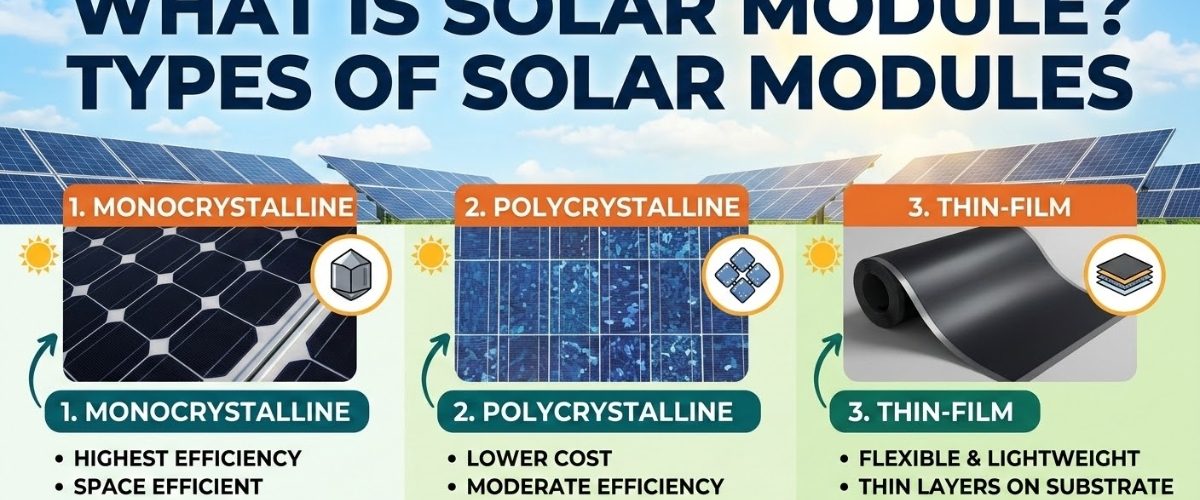
Solar modules are available in several types depending on the technology used in their solar cells. Each type has its own advantages, efficiency levels, and cost.
1. Monocrystalline Solar Modules
Monocrystalline solar modules are made from single-crystal silicon cells. These panels are known for their high efficiency and sleek black appearance.
Features
- High energy efficiency
- Better performance in low-light conditions
- Long lifespan of around 25–30 years
- Requires less space for installation
Advantages
- Highest efficiency among solar modules
- Durable and reliable
- Suitable for residential rooftop systems with limited space
Disadvantages
- Higher cost compared to other panel types
Because of their efficiency, monocrystalline modules are widely used in residential and commercial solar installations.
2. Polycrystalline Solar Modules
Polycrystalline solar modules are made by melting multiple silicon fragments together to form solar cells.
Features
- Slightly lower efficiency than monocrystalline panels
- Blue colored cells with a speckled appearance
- Cost-effective manufacturing
Advantages
- More affordable than monocrystalline panels
- Reliable performance
- Widely used in residential solar projects
Disadvantages
- Requires more space for the same energy output
- Slightly lower efficiency
Polycrystalline modules are commonly used where budget is a major consideration.
3. Thin-Film Solar Modules
Thin-film solar modules are produced by depositing thin layers of photovoltaic materials onto surfaces like glass, plastic, or metal.
Features
- Lightweight and flexible
- Easier to manufacture
- Can be used on curved surfaces
Advantages
- Flexible installation options
- Lower production costs
- Good performance in high temperatures
Disadvantages
- Lower efficiency compared to crystalline panels
- Requires larger installation area
Thin-film modules are often used in large solar farms, portable solar systems, and specialized applications.
Other Types of Solar PV Modules
Modern solar technology has introduced several advanced module designs.
Bifacial Solar Modules
Bifacial panels generate electricity from both the front and back sides, increasing energy production.
Monofacial Solar Modules
These are traditional panels that generate electricity from only the front side.
P-Type Solar Modules
P-type modules use boron-doped silicon cells and are commonly used because of their lower manufacturing cost.
N-Type Solar Modules
N-type modules use phosphorus-doped silicon and offer higher efficiency, lower degradation, and longer lifespan.
Efficiency of Solar Modules
Solar module efficiency indicates how much sunlight can be converted into electricity.
Typical efficiency levels include:
- Standard solar panels: 15% – 18%
- High-efficiency panels: 18% – 22%
- Advanced modules: up to 23% efficiency
Higher efficiency modules can generate more electricity from a smaller installation area.
Lifespan of Solar Modules
Most modern solar modules have a lifespan of 25 to 30 years. Even after this period, the panels can still generate electricity but at slightly reduced efficiency.
Manufacturers usually provide performance warranties of 25 years, guaranteeing that panels will still produce a certain percentage of their original capacity.
Applications of Solar Modules
Solar modules are widely used in various sectors, including:
- Residential rooftop solar systems
- Commercial and industrial buildings
- Large solar power plants
- Agricultural irrigation systems
- Solar street lighting
- Electric vehicle charging stations
- Off-grid rural electrification
These applications help reduce dependence on fossil fuels and promote clean energy generation.
Conclusion
Solar modules are the foundation of modern solar energy systems. They convert sunlight into electricity using photovoltaic technology and provide a clean, renewable source of power. With different types such as monocrystalline, polycrystalline, and thin-film modules, users can choose the most suitable option based on efficiency, cost, and installation requirements.
As solar technology continues to improve, solar modules are becoming more efficient, durable, and affordable, making solar energy an increasingly attractive solution for powering homes, businesses, and entire communities.